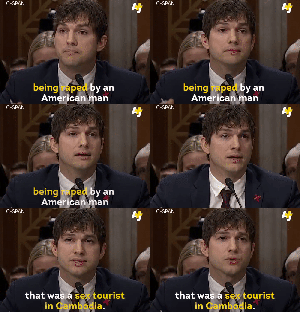
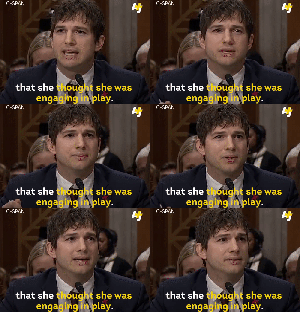
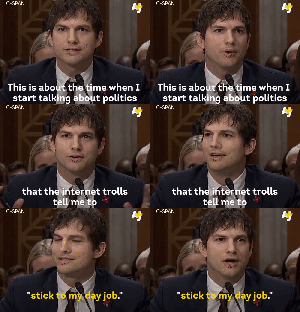
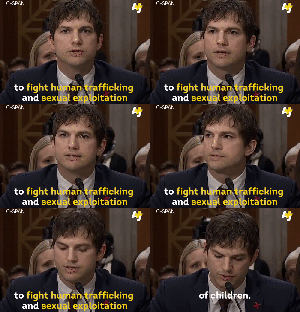
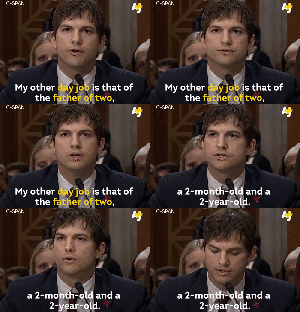
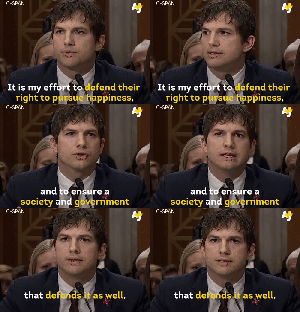
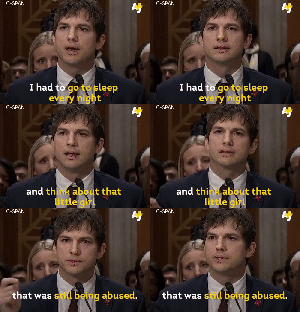
Even the idea that there is a video where an American man rape a kid makes me sick. Ashton Kutcher is doing a great job by using his power and privilege to raise awareness about human trafficking. Every parent dreams of the bright, happy and SAFE future to his/her child. This guy tries to change this country, this world into a better one. This Hollywood celebrity woke up and tried to draw the government’s attention to this very crucial problem of child trafficking.
Honestly God bless Ashton Kutcher and anybody else who is actively engaged in the fight against child trafficking. People telling him it’s “not his place” can stick it up their ass, this is a real problem and he’s actually doing something about it, and I applaud him wholeheartedly.
Susanna and the Elders, Restored with X-ray (Right)
Kathleen Gilje, 1998
Oooh my gosh this is rad. This is so rad.
For those who don’t know about this painting, the artist was the Baroque artist Artemisia Gentileschi.
Gentileschi was a female painter in a time when it was very largely unheard of for a woman to be an artist. She managed to get the opportunity for training and eventual employment because her father, Orazio, was already a well established master painter who was very adamant that she get artistic training. He apparently saw a high degree of skill in some artwork she did as a hobby in childhood. He was very supportive of her and encouraged her to resist the “traditional attitude and psychological submission to brainwashing and the jealousy of her obvious talents.”
Gentileschi became extremely well known in her time for painting female figures from the Bible and their suffering. For example, the one seen above depicts the story from the Book of Daniel. Susanna is bathing in her garden when two elders began to spy on her in the nude. As she finishes they stop her and tell her that they will tell everyone that they saw her have an affair with a young man (she’s married so this is an offense punishable by death) unless she has sex with them. She refuses, they tell their tale, and she is going to be put to death when the protagonist of the book (Daniel) stops them.
So that painting above? That was her first major painting. She was SEVENTEEN-YEARS-OLD. For context, here is a painting of the same story by Alessandro Allori made just four years earlier in 1606:
Wowwwww. That does not look like a woman being threatened with a choice between death or rape. So imagine 17 year old Artemisia trying to approach painting the scene of a woman being assaulted. And she paints what is seen in the x-ray above. A woman in horrifying, grotesque anguish with what appears to be a knife poised in her clenched hand. Damn that shit is real. Who wants to guess that she was advised by, perhaps her father or others, to tone it down. Women can’t look that grotesque. Sexual assault can’t be depicted as that horrifying. And women definitely can’t be seen as having the potential to fight back. Certainly not in artwork. Women need to be soft. They need to wilt from their captors but still look pretty and be a damsel in distress. So she changed it.
What’s interesting to note is that she eventually painted and stuck with some of her own, less traditional depictions of women. However, that is more interesting with some context.
(Warning for reference to rape, torture, and images of paintings which show violence and blood.)
So, Gentileschi’s story continues in the very next year, 1611, when her father hires Agostino Tassi, an artist, to privately tutor her. It was in this time when Tassi raped her. He then proceeded to promise that he would marry her. He pointed out that if it got out that she had lost her virginity to a man she wasn’t going to marry then it would ruin her. Using this, he emotionally manipulated her into continuing a sexual relationship with him. However, he then proceeded to marry someone else. Horrified at this turn of events she went to her father. Orazio was having none of this shit and took Tassi to court. At that time, rape wasn’t technically an offense to warrant a trial, but the fact that he had taken her virginity (and therefore technically “damaged Orazio’s property”. ugh.) meant that the trial went along. It lasted for 7 months. During this time, to prove the truth of her words, Artemisia was given invasive gynecological examinations and was even questioned while being subjected to torture via thumb screws. It was also discovered during the trial that Tassi was planning to kill his current wife, have an affair with her sister, and steal a number of Orazio’s paintings. Tassi was found guilty and was given a prison sentence of…. ONE. YEAR……. Which he never even served because the verdict was annulled.
During this time and a bit after (1611-1612), Artemisia painted her most famous work of Judith Slaying Holofernes. This bible story involved Holofernes, an Assyrian general, leading troops to invade and destroy Bethulia, the home of Judith. Judith decides to deal with this issue by coming to him, flirting with him to get his guard down, and then plying him with food and lots of wine. When he passed out, Judith and her handmaiden took his sword and cut his head off. Issue averted. The subject was a very popular one for art at the time. Here is a version of the scene painted in 1598-99 by Carivaggio, whom was a great stylistic influence on Artemisia:
This depiction is a pretty good example of how this scene was typically depicted. Artists usually went out of their way to show Judith committing the act (or having committed it) while trying to detach her from the actual violence of it. In this way, they could avoid her losing the morality of her character and also avoid showing a woman committing such aggression. So here we see a young, rather delicate looking Judith in a pure white dress. She is daintily holding down this massive man and looks rather disgusted and upset at having to do this. Now, here is Artemisia’s:
Damn. Thats a whole different scene. Here Holofernes looks less like he’s simply surprised by the goings ons and more like a man choking on his own blood and struggling fruitlessly against his captors. The blood here is less of a bright red than in Carrivaggio’s but is somehow more sickening. It feels more real, and gushes in a much less stylized way than Carrivaggio’s. Not to mention, Judith here is far from removed from the violence. She is putting her physical weight into this act. Her hands (much stronger looking than most depictions of women’s hands in early artwork) are working hard. Her face, as well, is completely different. She doesn’t look upset, necessarily, but more determined.
It’s also worth note that the handmaiden is now involved in the action. It’s worth note because, during her rape trial, Artemisia stated that she had cried for help during the initial rape. Specifically she had called for Tassi’s female tenant in the building, Tuzia. Tuzia not only ignored her cries for help, but she also denied the whole happening. Tuzia had been a friend of Artemisia’s and in fact was one of her only female friends. Artemisia felt extremely betrayed, but rather than turning her against her own gender, this event instilled in her the deep importance of female relationships and solidarity among women. This can be seen in some of her artwork, and I believe in the one above, as well, with the inclusion of the handmaiden in the act.
So, I just added a million words worth of information dump on a post when no one asked me, but there we go. I could talk for ages about Artemisia as a person and her depictions of women (even beyond what I wrote above. Don’t get me started on her depictions of female nudes in comparison to how male artists painted nude women at the time.)
To sum up: Artemisia Gentileschi is rad as hell. This x-ray is also rad as hell and makes her even radder.
I love art history.
I’m reblogging this again to add something that I also think is important to know about Artemisia Gentileschi. Back in her time and through even to TODAY, there are people who argue that her artworks were greatly aided by her father…. As in he either helped her paint them or just straight up painted them himself. Hell, there are a number of works only recently (past several years or so) that have been officially attributed to Artemisia because people originally saw the signature with “Gentileschi” in it and automatically attributed it to Orazio. So, not only was Artemisia Gentileschi an amazing artist and amazing historical figure, but I don’t want it to be ignored that there are people over 400 years later who still won’t give her the credit she deserves, just because she’s a woman and obviously women can’t paint like she did.
I fucking love Artemisia Gentileschi!!
Just because by reading this post I have learnt a lot and it´s worth sharing. Now i know a new painter Artemisia Gentileschi !
…No, I hadn’t. That seems a bit absurd. I mean, I know Hussie mentions IRL people in Homestuck, but making up a kid as one of their characters? I do think there’s a high chance he’s adopted though. I mean, technically the players are their own self contained species. Who knows if they can even have kids with normal humans.
I have (sorta) debunked the idea that Dad is Nanna/Harry Anderson’s child before but lets do it again.
Nanna was born in 1910, Harry Anderson was born in 1952. That means that when he was born, Nanna was already 42. The average age of menopause is 51 (according to Wikipedia), but lets just give Nanna as a Life player the upper age of 55. When Nanna was 55, Harry Anderson was 13. So yeah, the only way that Dad would be the child of Harry Anderson and Nanna would be to make Nanna a child rapist.
no, but, more serious hot take. daken is a black widow trope. he is manipulative, he does use coercion, and consent with him is always at best questionable and at worst nonexistent. this is the “seductive spy”. he’s seen as a larger threat than most black widows because he’s a man, and that’s fine. i deeply believe there are men who find the black widow trope on women just as distasteful. for many people anything less than perfectly crystal consent will always, always be violence. and you need to be respectful of that.
This was my ‘favourite little Buffy thing’(I was the one who submitted it), but really when I say ‘favourite thing’, I mean ‘that Buffy thing that rips my heart out through my chest whenever I think about it.’
I mean;
Doyle: Struggling to deal with his half-demon roots, Doyle’s relationship with his wife falls apart, and they get divorced even though it’s obvious they loved one another very much. Doyle turns to drinking and gambling (both of which he is implied to have an addiction to). This is perhaps to drown out the guilt of letting his demon kin get massacred after refusing to help them. Dies young saving a group of half-demons as penance.
Cordelia: Family is sent to prison for tax evasion, leaving her unable to go to university, and all alone without a family. Her dreams of becoming an actress fail spectacularly. All the men she has ever loved (Xander, Doyle, Angel) has either cheated on her, died, or in some way never worked out with her. Is struck not once but twice by a horrible demonic pregnancy, is left in a coma, and at one point is forced to feel all the collective misery of the entire world.
Drusilla: Is stalked, tortured, raped (or at least very strongly implied to have been raped), brainwashed, driven insane, and ultimately enslaved by a pair of vicious vampires who forced her to watch the brutal deaths of her family. She was driven insane with the guilt of her visions, and believes herself to be evil long before she actually was. Her relationship with Spike- the only person who was halfway decent to her- falls apart at least partially due to a vision of him falling in love with The Slayer he swore to kill for her. She tries to bring her ‘family’ back together out of love and loneliness, but all she gets for her efforts is set on fire, then tazered, tied up, and offered as a sacrifice by Spike. The one person who genuinely cared for her. She then wanders the world alone, unable to properly look after herself due to the debilitating insanity she suffers. And let’s not even get into the trauma tango she dances all by herself in the comics…
Cassie: Has a alcoholic, allegedly violent father who divorced her mother on bad terms. Is a outcast at school where she has no friends, nor ambition for the future. Knows exactly when she’s going to die (young), and that there is not a single thing she can do about it. Even a Slayer couldn’t save her.
You could argue that if they never had the visions, a lot (perhaps not all, but a lot) of the pain and heartbreak would never of happened to them…
Would Cassie of fallen into the lonely and fatalistic state she wallowed in if she wasn’t plagued with knowledge of the future, and knowledge of her death?
Would Doyle’s crippling guilt for not helping his kin of been so unbearable if he hadn’t seen the vision of them being massacred?
Would Darla and Angelus of picked out Drusilla as a ragdoll to toss around if they didn’t know she had The Sight? Alternatively, would Drusilla and Spike of fallen apart if she hadn’t foreseen his infatuation with Buffy?
Being a seer must be the suckiest gift ever. It’s like being blessed with a death sentence, or excitedly opening a present to find someone’s sent you a box of venomous snakes.
I am not a huge fan of Angel, but I’m also not running a group determined to murder him with rusty spoons. HOWEVER. If there’s any one reason why I will not join his fanclub it’s because of how he treats Drusilla. He told Buffy that he regretted everything he did to her, but he never actually acted like it. He was almost nicer to her when he was ANGELUS than he was when he was souled.
Angel always treated Drusilla like he found her to be annoying. He was irritated by her and the way she acted. Like he wasn’t the one who stalked her, murdered everyone she was close to, raped her, drove her to insanity, and then turned her into a vampire to make sure that her suffering would be eternal. If he was so regretful of his actions, why would he treat her as though she was just an aggravation to him? If he really felt bad everything he’d done, shouldn’t he act like it? Everyone thinks of him as a hero, but I’m not so sure.
Drusilla deserved so much more than what she was given from life. She wanted to be pure. And Angelus took that away from her. He took everything away from her. He condemned her to a life that was so hellish that she may never even realize that she’s in hell if someone kills her off.
I think what Angel did to Drusilla is unforgivable. There’s no making excuses for it.
Hi! ❤ That’s a pretty plausible Doylist explanation. :3 I personally prefer reasoning on a Watsonian level, but the fact that Dru was a minor character- a minor antagonist, no less – probably factored into it. Why waste time reflecting on characters who aren’t relevant to the main plot, after all? Drusilla is only in twenty four episodes of the Buffyverse- less than 10% of the series- so Angel reminiscing on her in every episode would only serve to stifle and distract from the active plot. I think we’re just meant to assume he agonizes over it conveniently off-screen.
It’s not that we’re not shown him being haunted by the horrors he caused Drusilla that bothers me; Angel rarely expresses guilt loudly and proudly. He doesn’t seem the sort to scream about his regret at the top of his lungs. He’s the type who would let it fester quietly under his skin like a broken rib; nobody can see how much pain he’s in, but it hurts him to breathe. Hence the sulking in a sewer for decades; it was easier for him to just retreat into himself than be vocal and proactive about his remorse. So him not talking often about Drusilla makes sense to me. That’s not why I sometimes don’t buy that he’s sincerely sorry about it.
The reason I question Angel’s guilt is because he set Drusilla on fire and then bragged about it to Kate. The reason I question Angel’s guilt is because he joked about Drusilla “being fickle” to Spike, ignoring or dare I say even reveling in the fact that it’s his fault that she’s so emotionally unstable. Because he seemed horrified at the idea of giving up on Faith, but apparently saw Drusilla as irredeemable. Inconsistencies and double standards like that is why I question Angel’s guilt.
Alas, it’s not just Drusilla; Angel is the kind of character who’ll preach about unconditional forgiveness one moment and order the cold-blooded murder of Lindsey (who wanted to change his ways) the next. He’s the sort of character who’ll claim being riddled with self-loathing for his crimes one moment and boast about eating his own parents the next (Sense and Sensitivity). Lindsey had to die for turning a blind eye to the corrupt nature of his employers for two years. Angel deserves infinite chances in spite of murdering, raping, and torturing an entire continent of people for two hundred years. Lindsey did it to escape poverty. Angel did it because he could. The moment Lindsey truly realized how depraved Wolfram and Hart was he fled of his own free will, turning down a promotion and risking his life in the process. When Angel got a soul and realized how horrible his own actions were he tried to carry on as normal for two years. It’s more or less irrefutable that Angel has much more blood- quite literally in many cases- on his hands than Lindsey. Doylist explanation? Different writers had different interpretations of Angel as a character, thus leading to the contradiction in his philosophies. Watsonian explanation? Angel is not quite as heroic as we’re led to believe. And as previously established, I’m a sucker for Watsonian theories.
God Tier: Halloween, Lie To Me, Surprise, Innocence, Passion, Becoming Part 1, Becoming Part 2, Band Candy, The Wish, The Zeppo, Doppelgangland, Something Blue, Hush, Superstar, Restless, Fool For Love, The Body, The Gift, Once More With Feeling, Tabula Rasa, Selfless
High Tier: Angel, Nightmares, Prophecy Girl, School Hard, What’s My Line Part 1, What’s My Line Part 2, Phases, I Only Have Eyes For You, Anne, Faith Hope and Trick, Homecoming, Revelations, Lover’s Walk, Helpless, Bad Girls, Consequences, Enemies, Earshot, Choices, Graduation Day Part 1, Graduation Day Part 2, Fear Itself, Pangs, A New Man, This Year’s Girl, Who Are You, Primeval, Buffy vs Dracula, The Real Me, The Replacement, Family, Checkpoint, Blood Ties, Intervention, Tough Love, Life Serial, All the Way, Hell’s Bells, Villains, Two to Go, Grave, Lessons, Same Time Same Place, Help, Conversations With Dead People, Potential, Storyteller, Chosen
MidTier: Welcome to the Hellmouth, The Harvest, Witch, Never Kill a Boy on the First Date, The Pack, The Puppet Show, Out of Sight Out of Mind, When She Was Bad, Inca Mummy Girl, The Dark Age, Bewitched Bothered and Bewildered, Go Fish, Beauty and the Beasts, Amends, Gingerbread, The Prom, Wild at Heart, The Initiative, Doomed, The I in Team, Goodbye Iowa, New Moon Rising, The Yoko Factor, Out of My Mind, Triangle, Crush, I Was Made to Love You, Forever, The Weight of the World, Bargaining Part 1, Bargaining Part 2, Smashed, Wrecked, Gone, Doublemeat Palace, Dead Things, Older and Far Away, Normal Again, Him, The Killer in Me, Dirty Girls
Low Tier: Teacher’s Pet, I Robot You Jane, Reptile Boy, Ted, Killed By Death, Dead Man’s Party, The Freshman, Living Conditions, The Harsh Light of Day, Where the Wild Things Are, No Place Like Home, Shadow, Listening to Fear, Into the Woods, Spiral, After Life, Flooded, As You Were, Entropy, Seeing Red, Beneath You, Sleeper, Never Leave Me, Bring on the Night, Showtime, First Date, Lies My Parents Told Me, Empty Places, Touched, End of Days
Shit Tier: Some Assembly Required, Bad Eggs, Beer Bad, Get it Done
I agree with a lot of this and disagree with a lot of it. Personally, I don’t think that Faith’s character really takes off until we get the sliced-up psychotic POV shots when she goes to Angel; any storyline that gives one character/species as much power as Jonathan or the vengeance demons seem to have sets my continuity-protection sensors to beeping; and I don’t really despise any of the episodes in OP’s Shit Tier. I’d love to see you break down a few of the episodes into your specific likes and dislikes, though.

With pleasure! ❤
To provide some variety, I’ve picked one random episode from each tier. Without further ado…
The Zeppo (God tier): Xander Harris isn’t my favourite character. I don’t hate him, but I have at times joined the chorus of condemnation for his less-than-endearing traits, like getting away with some pretty major screw-ups (Becoming Part 2, Once More With Feeling), making sexist comments, or just his general mean-spirited streak. I would also agree that his character hasn’t aged well, drawing more ire with every new generation of fans who are well equipped to recognise a Nice Guy ™ when they see one. However, there is something compelling about the idea of an everyman in a cast of Chosen Ones and super heroes. This episode takes that concept and elevates it into a masterpiece. It’s hilarious. It’s touching. It’s bittersweet. It’s unique. It’s the most likable Xander has ever been. I was roaring with laughter throughout this episode, every punchline landed, every joke tickled me. Just the premise of there being a huge apocalypse and only getting to see snippets of it while our everyman embarks on a side-quest made me giddy. But in the final scene, we see there is a deeper purpose to this episode than its shenanigans (and even if there was not, the shenanigans alone were more than enough to earn this episode a place in my heart). Here, we’re given the impression that Xander might be ready to move past the ugliness of his insecurities. My only complaint is that I wish the character development had stuck.
Life Serial (high tier): “Life is the Big Bad” – as Marti Noxon remarked of season six – was never better expressed than in this criminally underrated episode. Grimly amusing and painfully relatable, here we see Buffy attempt to reacclimatise to everyday life, only she just can’t seem to do anything right. Unbeknownst to her, she is being magically targeted by The Trio, who are tormenting her in profoundly lame and mundane ways. But they are still tormenting her. Haha, Buffy goes to college to try and learn things but the day just speeds by in a second and she has no idea what she’s doing! Haha, Buffy’s retail shiftjust never seems to end! Ever! Haha, Buffy is drinking to distract from her fear and uncertainty about the future! I first saw this episode when I was fifteen, and honestly I didn’t really ‘get it’ then. Call it blissful ignorance. But oh boy, I understand this episode now. This is the perfect encapsulation of season six’s mission statement, and it really deserves more appreciation.
When She Was Bad (mid tier): This episode was a game changer. Here we see the first hints of the series shedding its ‘Monster of the Week’ format in favour of long-running continuity with high emotional stakes. Here we see for the first time that what happens in the show can have lasting consequences for the characters. Buffy defeated The Master in last season’s finale, but the trauma of drowning has changed her forever, leaving her with PTSD that will make up part of who she is for the rest of the series. And so one of the most subtly tragic aspects of the Buffyverse is born. As I explained in this post- contrary to popular misconception – mid-tier isn’t reserved for average episodes, but good episodes. This was a good episode. It is commonly accepted wisdom that the show didn’t mature past the wacky, episodic nature of season one until ‘Innocence’, but for me the real turning point was Buffy tearfully smashing the bones of The Master, never to be quite the same person again.
Seeing Red (low tier): I have no problem with TV shows tackling serious or taboo issues. If something exists, then it has a place in fiction. If handled well, then storylines dealing with sexual abuse can spread awareness of the issue and give a voice to the survivors of that trauma. I don’t even think the attempted rape was out of character for Spike (an amoral demon), as so many have insisted it was. But my God, I don’t think the writers could have handled this storyline more thoughtlessly if they tried. Using your female lead’s traumatic near-rape experience to spur on the attempted rapist’s character development, making the victim an accessory for his redemption arc? Bad move. Bad, bad, bad move. This is the first time that I felt Buffy was really betrayed by the writers, the first time she was used as a disposable plot device for Spike. This trend continued into the seventh season, and felt like a cruel betrayal of the show’s core values. Killing off Tara in the same episode she finally became a series regular was also a slap in the face to LGBT fans, who at the time had very few lesbian role models in media. The more I think about it, the less sure I am as to why I saved it from shit tier. Certainly it did more harm than ‘Some Assembly Required’ or ‘Beer Bad’, which were laughably atrocious but not an insult to everything the show claimed to stand for like this was. Speaking of…
Beer Bad (shit tier): this is the shortest episode in the series if memory serves me correctly, but it somehow feels like the longest. Rumour has it that the writers were paid by an alcohol awareness charity to write this episode, and I don’t know if that’s true, but it definitely feels like that. Perhaps the only enjoyable part of the episode was Willow chewing out Parker Abrams. Ironically one of the few episodes of Buffy to be nominated for an Emmy (for outstanding hairstyling, I believe). I was lucky enough that my introduction to the series was the epic character study ‘Fool For Love’, but had it been ‘Beer Bad’? I doubt I would have ever watched another episode.