If nearly a decade interviewing the wealth managers for the 1% taught me anything, it is that the ultra-rich and the ultra-poor have a lot more in common than stereotypes might lead you to believe.
In conversation, wealth managers kept coming back to the flamboyant vices of their clients. It was quite unexpected, in the course of discussing tax avoidance, to hear professional service providers say things like:
“I’ve told my colleagues: ‘If I ever become like some of our clients, shoot me.’ Because they are really immoral people – too much time on their hands, and all the money means they have no limits. I was actually told by one client not to bring my wife on a trip to Monaco unless I wanted to see her get hit on by 10 guys. The local sport, he said, was picking up other men’s wives.”
The clients of this Geneva-based wealth manager also “believe that they are descended from the pharaohs, and that they were destined to inherit the earth”.
If a poor person voiced such beliefs, he or she might well be institutionalized; for those who work with the wealthy, however, such “eccentricities” are all in a day’s work. Indeed, an underappreciated irony of accelerating economic inequality has been the way it has exposed behaviors among the ultra-rich that mirror the supposed “pathologies” of the ultra-poor.
In fact, one of the London-based wealth managers I interviewed said that a willingness to accept with equanimity behavior that would be considered outrageous in others was an informal job requirement. Clients, he said, specifically chose wealth managers not just on technical competence, but on their ability to remain unscandalized by the private lives of the ultra-rich: “They [the clients] have to pick someone they want to know everything about them: about Mother’s lesbian affairs, Brother’s drug addiction, the spurned lovers bursting into the room.” Many of these clients are not employed and live off family largesse, but no one calls them lazy.
As Lane and Harburg put it in the libretto of the musical Finian’s Rainbow:
When a rich man doesn’t want to work
He’s a bon vivant, yes, he’s a bon vivant
But when a poor man doesn’t want to work
He’s a loafer, he’s a lounger
He’s a lazy good for nothing, he’s a jerk
When the wealthy are revealed to be drug addicts, philanderers, or work-shy, the response is – at most – a frisson of tabloid-level curiosity, followed by a collective shrug.
Behaviors indulged in the rich are not just condemned in the poor, but used as a justification to punish them, denying them access to resources that keep them alive, such as healthcare and food assistance. Discussion of poverty has become almost impossible without moral outrage directed at lazy “welfare queens”, “crackheads” and other drug addicts, and the “promiscuous poor” (a phrase that has cropped up again and again in discussions of public benefits over more than a century).
These disparate perceptions aren’t just evidence of hypocrisy; they are literally a matter of life and death. In the US, the widespread belief that the poor are simply lazy has led many states to impose work requirements on aid recipients –even those who have been medically classified as disabled. Limiting aid programs in this way has been shown to shorten recipients’ lives: rather than the intended consequence of pushing recipients into paid employment, the restrictions have simply left them without access to medical care or a sufficient food supply. Thus, in one of the richest counties in America, a boy living in poverty died of a toothache; there were no protests, and nothing changed.
Meanwhile, the “billionaire” in the White House starts his days at 11am – the rest of the morning is coyly termed “executive time” – and is known for his frequent holidays. “Nice work if you can get it,” quipped an opinion piece in the Washington Post.
We don’t hear much about laziness, drug addiction or promiscuity among the wealthiest members of society because – unlike Trump – most billionaires are not public figures and go to great lengths to seek privacy. Thus the motto of one London-based wealth management firm: “I want to be invisible.” This company, like many other service providers to the ultra-rich, specializes in preserving secrecy for clients. The wealthy people I studied not only had wealth managers but often dedicated staff members who killed negative stories about them in the media and kept their names off the Forbes “rich list”.
Many even present themselves as homeless – for tax purposes – despite owning multiple residences. For the ultra-rich, having no fixed residence provides major legal and financial advantages; this is exemplified by the case of the wealthy businessman who acquired eight different nationalities in order to avoid taxes on his fortune, and by the UK native I interviewed in his Dubai apartment building:
“I am not tax resident anywhere. The tax man says ‘show me a utility bill’, and the only utility bill I can present is for the house I own in Thailand, and it’s in a language that the European authorities aren’t familiar with. With all the mobility going on in the world, international marriages, governments can’t keep up with people.”
Meanwhile, the poor can end up being “resident nowhere” because no one will allow them to stay in one place for very long; as the sociologist Cristobal Young has shown, the majority of migrants are poor people. In addition, the poor are routinely evicted from housing on the slightest pretext, frequently driving them into homeless shelters – which are in turn forced to move when local homeowners engage in nimby (not in my back yard) protests. Even the design of public spaces is increasingly organized to deny the poor a place to alight, however temporarily.
It is as if the right to move around, to take up space, and to direct your own life as you see fit have become luxury goods, available to those who can pay instead of being human rights. For the rich, deviance from social norms is nearly consequence-free, to the point where outright criminality is tolerated: witness the collective shrug that greeted revelations of massive intergenerational tax fraud in the Trump family.
For the poor, however, even the most minor deviance from others’ expectations – like buying ice cream or soft drinks with food stamps – results in stigmatization, limits on their autonomy, and deprivation of basic human needs. This makes life far more nasty, brutish and short for those on the lowest rungs of the socio-economic ladder, creating a chasm of more than 20 years in life expectancy between rich and poor. This appears to some as a fully justified consequence of “personal responsibility” – the poor deserve to die because of their moral failings.
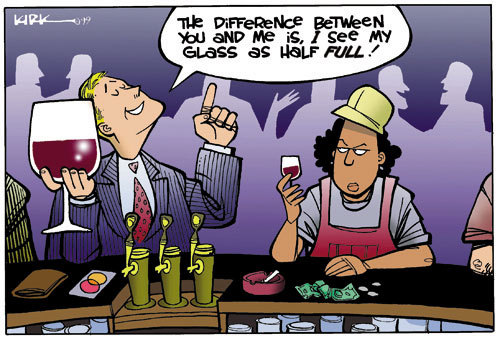
So while the behavior of the ultra-rich gets an ever-widening scope of social leeway, the lives of the poor are foreshortened in every sense. Once upon a time, they were urged to eat cake; now the cake earns them a public scolding.



 Cheloneuniverse