(Note: this is a long-winded rant(?) about a genuinely minuscule thing that really is just an excuse to nerd out, so if you’re into that, too, keep reading! Otherwise, you might not be that impressed. )
Yup, still on the My Hero Academia bender. Followers may have picked up my obsession over this purple-haired character named Shinsou in particular, but let me tell you that this character has less than some 20 pages in the manga and less than 20 minutes of screen time in the anime and is already more nuanced, complex, and emotionally compelling in that time than most of the characters in the protagonist’s immediate circle.
There are character analyses out there that do a great job of explaining all those points (this is one of the best I’ve seen and you should probably read that first and come back: http://manipulatorshinsou.tumblr.com/post/166609989279/the-appeal-of-shinsou-hitoshi-analyses), but I want to point out a tiny detail that I feel like almost no one has explicitly brought up that says something so enormous about his character arc that, though redundant at this point, is such a small but lovingly crafted detail that it really encapsulates one of my favorite things about this series – subtle emotional storytelling.
Now, there’s mild spoilers for all this, but you REALLY should go watch/read this series at some point anyway. However, I wanted to point something out that’s unique to the anime adaptation. Though some details often get left out in the adaptation process or are edited to fit film storyboarding rather than comics, film has a distinct advantage over manga in two areas – color and space.
Now, the entire point of Shinsou and Midoriya’s duel in the Tournament Arc was to draw multiple direct parallels to each character and highlight the major and really only significant difference between them – luck. In the end, both must fight an uphill battle above and beyond what would be expected of them to achieve their dream; but unlike Midoriya, Shinsou loses and his dreams are dashed. He’s no longer just disillusioned with the popularity games of hero society – he becomes discouraged and disheartened completely from having every last effort and every last plan easily pushed aside from someone more fortunate than him despite his efforts to appear confident and intimidating and to put his rivals off-balance.
Midoriya knows exactly the kind of struggle Shinsou has been through, and half the battle was to keep himself from trying to comfort Shinsou, not just because of All Might’s secret, but because they were rivals fighting for their own individual dreams, and attempting to help him would have resulted in Midoriya losing the match and the tournament. He also knew that after the fact there was nothing he could have said to Shinsou that would have given him comfort. Despite every amazing effort, he would once again be put down – the loser who just has to deal with the cruel reality of life.
Okay, nerd analysis time!
MHA is amazing at being emotionally compelling. They hit just the right line of performance, framing, and music to make you feel exactly what it wants you to. The example in particular I want to bring up is this scene (that legit put my husband -who is very much a “manly man”- in tears when he watched it).
At this point, Midoriya is told by the person he looks up to and admires more than literally anyone else in the world that regardless of his past inability to even come close to reaching his goals he still had the power to become a hero because of something beside and far beyond just having a powerful quirk.
And Midoriya is broken and in tears.
The cherry blossoms are a detail unique to the anime regarding this scene (Chapter 1) and really serve to add to the drama of it – particularly because of the saturation of color and the cultural significance of the Japanese sakura: the beauty and fleeting nature of youth, the coming of spring, and renewal. The Japanese consider the falling of the cherry blossoms to be a reminder that “it’s time to pay attention to what’s happening right now!”
Midoriya has finally experienced his own blossoming as a hero. Based on the scene in this episode and the direction the petals are falling insinuate that this feeling is all around him. His hero is standing over him and telling him that he can become just as great as he is. Everything at that moment has come together to recognize his dream.
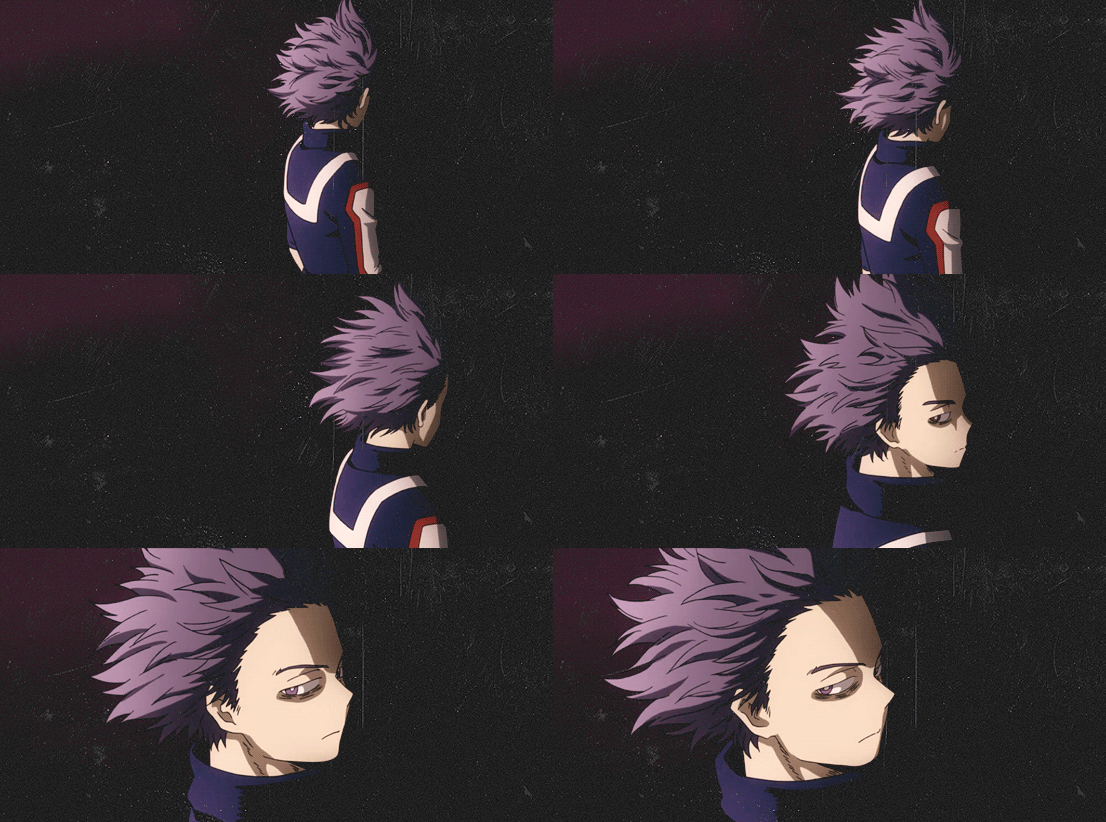
Fast forward to Shinsou’s flashback at the tournament:
Absolutely the cherry blossoms are there, and it’s even clear in the manga that there are cherry blossoms outside the class window. However, what happens in this scene is that Shinsou recollects a point in his life that he considers to be the epitome of his struggle.
“Whoa, Shinsou! That’s a really cool quirk! Just don’t use it on us and make us your slaves, okay?”
“Heh, everybody says that…”
And the scene goes grey.
This should have been his chance to break out and come closer to his dream, but that wasn’t the case. No color, no focus- just a blurred, painful memory to encapsulate the seemingly inescapable feeling of defeat as he lays on the ground, out of bounds, so close but yet so far once again…
And then-
~~~~~~
“You’re amazing, Shinsou!”
“You’re the shining star of General Studies!”
“His quirk is so powerful and can be so useful in capturing villains!”
“What a waste that he’s stuck in General Studies!”
“I wish I had a quirk like that!”
No “what a scary quirk” or “I hope he doesn’t use it for his own purposes”! Just:
“Look at what an amazing hero he could be!”
Did you see it?
There isn’t a cherry tree for miles around this arena. Everything for so long has been against him from the start. The fire inside him has all but been snuffed out yet again. This should be like every other disappointment he’s had to endure, and yet somehow it isn’t – against every odd.
He may have lost. He may have fallen short, but his real goal has been realized. He’s been seen.
It’s time to pay attention to what’s happening right now. Shinsou has blossomed.
It’s not as flashy or spectacular as Midoriya’s, but it’s just as significant. In fact, it’s exactly the same, regardless of how big it shows on the outside – Midoriya and Shinsou are the same, and they’ve both made it.
Again, this detail of the single petal falling isn’t in the manga (Chapter 34), but it was even more emotionally impactful to me than Midoriya’s awakening because I immediately saw the parallel. I feel that many did, too; but the choice to have the one fall into frame hit me where it counted. It almost wasn’t there, but it was!
I’m done rambling at this point, but really if you haven’t at least checked out this series yet, I highly encourage you to – even if you don’t like normally like anime! Most of the elements that tend to put me off of a lot of popular series are minimal or non-existent, and though it still uses major tropes in the shonen genre it has a tendency to go above and beyond philosophically, intellectually, and emotionally than it has to. It’s not a good anime. It’s a well-written and impactful story!




 Cheloneuniverse