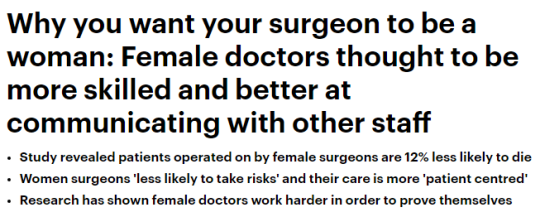
my professor spent our entire seminar whining about how there’s too many girls in our group and not enough boys. he was like “i’m not saying women can’t be good surgeons but we need more men” no, we don’t. men suck. deal with it.
CRY ALL YOU FUCKING WANT YOUR TEARS DON’T MEAN SHIT TO ME. YOUR TEARS MEAN DICK TO ME JUST SO YOU KNOW
Okay so not to be that person who adds on to a post with their own story but my mom is a doctor and when I was eleven she took me to these all-female seminar led by a woman who was the head of a hospital because my mom is an empowered and independent woman who wanted her daughter to be the same way and so there’s like thirty females surgeons in the room, all sitting around his huge circlular confrenece table and talking about their experiences in becoming surgeons
most of them were like “everyone told me I should become a nurse or a pediatrician” and “people assume that I don’t know what I’m doing” you know, your average sexist bs
one of the women’s last name was starboard (yeah I know great name) and she was talking about how even though now she was one of the most accomplished surgeons at the hospital, the male scrub techs (read: guys who didn’t go to fucking medical school) and some of the male doctors call her starbitch in the OR because they (scrub techs mostly, strangely enough) try to suggest different ways to care for the patient and she always tells them no you didn’t go to med school and I did and so they would go out of their way to get the male doctors to treat the patient differently and then she would have to argue with him to prove what she was doing es right but sometimes the male doctor would come and take over the case anyway and this went on for a while
but then the hospital statistics changed bc this woman was literally being prevented from treating her patients bc the men were interfering and so the administrative head heard about this (she was female) and she was like y’all better stop or y’all better start looking for new jobs and then starboard was allowed to work on her patients and got the scrub techs replaced and all of the sudden, the patients were suddenly doing much better during and after surgery.
when she told this story she was like “people still call me a bitch, and maybe I am because I won’t let them walk all over me, but when you’ve got something to do, when you’ve got a life to save, you have to ignore their bullshit so that you can save someone’s fuckin life. Sexism should never stop you from accomplishing that”
and little eleven-year-old me still remembers that bc I was insecure and awkward and here was this woman who just did what she had to do and ignored all the people trying to stop here and she really was better than all the male doctors (like her patient stats were better) and I thought I should share with you this inspiring woman with the cool last name
The push to revive America’s coal industry has generated alarm because it is almost certain to worsen the climate crisis. But the industry also brings an immediate human cost: black lung disease. Black lung is an often fatal condition contracted by miners who breathe in coal and silica dust on the job. Rates of the disease dropped towards the end of the 20th century, thanks in part to federally mandated reductions in the amount of coal dust miners were allowed to breathe in. Now, researchers at the National Institute for Occupational Safety and Health have documented a troubling new trend: Black lung disease cases, particularly among younger miners, have risen sharply since the mid-1990s.
One chart from the group, published by the New York Times earlier in 2018, shows that in 1995 there were “3.7 cases per 1,000 miners.” By 2015, that number had jumped to over 50 cases per 1,000 miners.
Overall, there has been a steady upsurge in the number of cases of black lung, including in its most aggressive forms. A 2018 National Public Radio report identified many reasons for the increase, including the fact that many miners are working longer hours with less time to rest and recover between shifts. Advances in mining technology have also led to the use of more powerful extraction machines that throw more toxic coal dust into the air and into the lungs of coal miners. These factors have made the coal mining regions of Appalachia the “epicenter of one of the worst industrial health disasters in U.S. history,” according to a recent article by Kentucky lawyer, Evan Smith.
Smith advocates on behalf of coal miners through his work at the Appalachian Citizens’ Law Center. Writing for the West Virginia Law Review, Smith calls the uptick in black lung cases evidence of a “gut-wrenching reversal of 20th century progress.” Black lung disease is preventable, Smith insists, and should have gone the way of smallpox long ago. (Black lung is actually not a medical term, Smith points out, and notes that it is just one name for a host of debilitating physical conditions experienced by miners.) Although mining has always been a dangerous occupation, rates of black lung disease did drop from the 1970’s until the beginning of the 21st century, thanks to improved workplace and environmental regulations.
Dangerous working conditions
Looking beyond black lung, recent incidents such as the 2010 Upper Big Branch mining disaster in West Virginia have shown that working conditions for coal miners often remain harrowingly unsafe. Portions of the Upper Big Branch mine exploded in 2010, killing 29 workers. In the aftermath, autopsies were carried out on a majority of the lungs of those killed, revealing that 71 percent of them had black lung disease, including a worker who was just 25 years old when he died. Upper Big Branch was owned then by Massey Energy, whose CEO, Don Blankenship, was sentenced to one year in prison for his role in making the mine an unsafe place to work.
One of the things that made the Upper Big Branch mine so unsafe was the fact that Blankenship had driven out the miners’ union. Blankenship, who is a current U.S. Senate candidate in West Virginia as a member of the Constitution Party, “made it his personal campaign to break the union at the mine,” according to a 2010 report by Public Radio International. This resulted in workers having to take on 12-hour shifts as one of Massey Energy’s reported cost-cutting measures. What followed was a number of articles arguing, as reporters Taylor Kuykendall and Hira Fawad did in 2015, that union-staffed mines are more productive and less dangerous for workers. One key piece of Farwad and Kuykendall’s evidence for this comes from safety records in 2014, when just one out of 16 work-related mining deaths occurred at a union site.
Despite Kentucky’s history of worker militancy, today there are zero union mines left in the state, which is at the heart of Appalachian coal country. Still, a group called Kentuckians for the Commonwealth continues to advocate on behalf of the thousands of coal miners who work in the state. Acknowledging the rise in black lung disease among miners, the group aims to move away from relying on toxic, fossil fuel industry jobs such as coal mining.
Not only will the Trump Tax Cut end up being the most egregious transfer of wealth in history, it is far worse cost wise than the lowball numbers R’s came up with.
First of all, “…they were surrounded on all sides by echoes and images of themselves, in a world where image and object had not yet torn themselves apart” is one of the most poetic phrasings I’ve ever heard.
Third, the original opens with: “Every so often, I get the urge to drag someone into a cave, and show them something unspeakable.”
I had another point, but it got lost in the artful prose of this article.
I feel like “every so often, I get the urge to drag someone into a cave and show them something unspeakable” is something that’s okay for a paleolithic cave art expert to say, but like, absolutely no one else






























 Cheloneuniverse