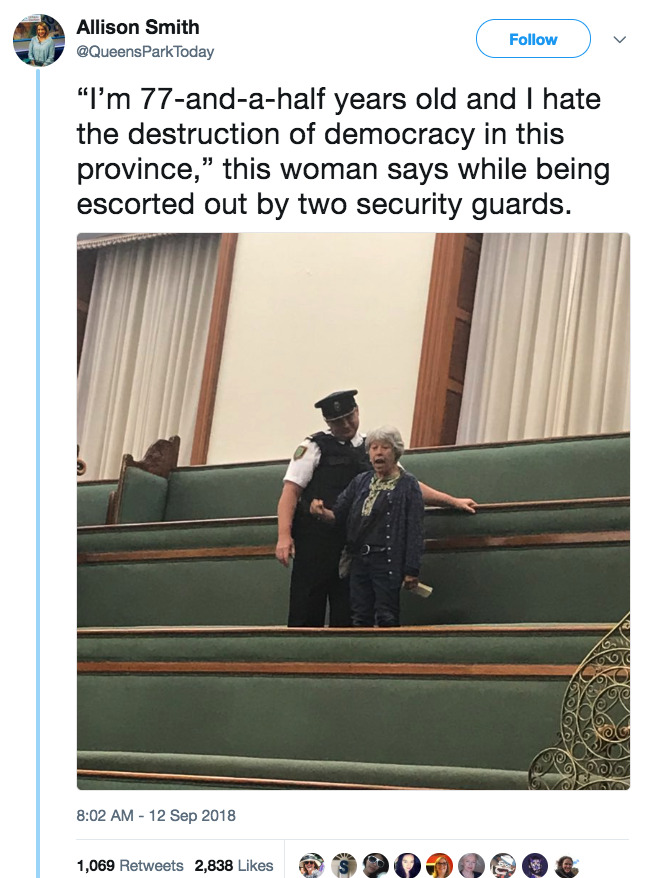
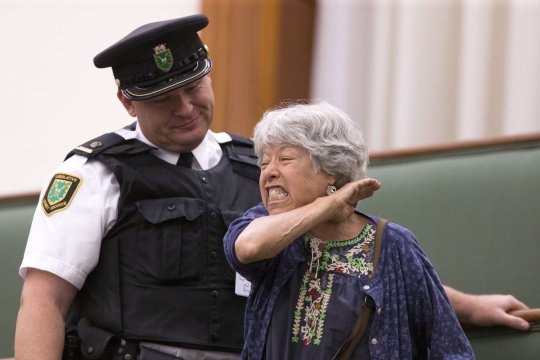
I want to be this much of a bad ass when I’m 77 years old:
“I’m 77-and-a-half years old and I hate the destruction of democracy in this province,” this woman says while being escorted out by two security guards.”
“Ester Reiter lived through discrimination as a Jew in Cold War America, marched to protest the Vietnam War with two babies in tow, and visited a mass grave in a southern Poland forest where her grandparents, aunts and uncles were likely murdered in the Holocaust.
When she woke up on Wednesday morning, the 77-year-old didn’t hesitate to stand up for what she says is another great injustice — the Ontario government passing legislation that a judge ruled violates the Constitution.
[…]
“How I honour my identity as a Jew is to get my ass out and protect everybody, to protect the rights and freedoms of everybody and really try to struggle against any injustice,” she said.”
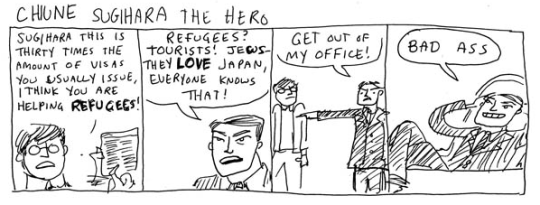
Chiune Sugihara. This man saved 6000 Jews. He was a Japanese diplomat in Lithuania. When the Nazis began rounding up Jews, Sugihara risked his life to start issuing unlawful travel visas to Jews. He hand-wrote them 18 hrs a day. The day his consulate closed and he had to evacuate, witnesses claim he was STILL writing visas and throwing from the train as he pulled away. He saved 6000 lives. The world didn’t know what he’d done until Israel honored him in 1985, the year before he died.
Why can’t we have a movie about him?
He was often called “Sempo”, an alternative reading of the characters of his first name, as that was easier for Westerners to pronounce.
His wife, Yukiko, was also a part of this; she is often credited with suggesting the plan. The Sugihara family was held in a Soviet POW camp for 18 months until the end of the war; within a year of returning home, Sugihara was asked to resign – officially due to downsizing, but most likely because the government disagreed with his actions.
He didn’t simply grant visas – he granted visas against direct orders, after attempting three times to receive permission from the Japanese Foreign Ministry and being turned down each time. He did not “misread” orders; he was in direct violation of them, with the encouragement and support of his wife.
He was honoured as Righteous Among the Nations in 1985, a year before he died in Kamakura; he and his descendants have also been granted permanent Israeli citizenship. He was also posthumously awarded the Life Saving Cross of Lithuania (1993); Commander’s Cross Order of Merit of the Republic of Poland (1996); and the Commander’s Cross with Star of the Order of Polonia Restituta (2007). Though not canonized, some Eastern Orthodox Christians recognize him as a saint.
Sugihara was born in Gifu on the first day of 1900, January 1. He achieved top marks in his schooling; his father wanted him to become a physician, but Sugihara wished to pursue learning English. He deliberately failed the exam by writing only his name and then entered Waseda, where he majored in English. He joined the Foreign Ministry after graduation and worked in the Manchurian Foreign Office in Harbin (where he learned Russian and German; he also converted to the Eastern Orthodox Church during this time). He resigned his post in protest over how the Japanese government treated the local Chinese citizens. He eventually married Yukiko Kikuchi, who would suggest and encourage his acts in Lithuania; they had four sons together. Chiune Sugihara passed away July 31, 1986, at the age of 86. Until her own passing in 2008, Yukiko continued as an ambassador of his legacy.
It is estimated that the Sugiharas saved between 6,000-10,000 Lithuanian and Polish Jewish people.
It’s a tragedy that the Sugiharas aren’t household names. They are among the greatest heroes of WWII. Is it because they were from an Axis Power? Is it because they aren’t European? I don’t know. But I’ve decided to always reblog them when they come across my dash. If I had the money, I would finance a movie about them.
He told an interviewer:
You want to know about my motivation, don’t you? Well. It is the kind of sentiments anyone would have when he actually sees refugees face to face, begging with tears in their eyes. He just cannot help but sympathize with them. Among the refugees were the elderly and women. They were so desperate that they went so far as to kiss my shoes, Yes, I actually witnessed such scenes with my own eyes. Also, I felt at that time, that the Japanese government did not have any uniform opinion in Tokyo. Some Japanese military leaders were just scared because of the pressure from the Nazis; while other officials in the Home Ministry were simply ambivalent.
People in Tokyo were not united. I felt it silly to deal with them. So, I made up my mind not to wait for their reply. I knew that somebody would surely complain about me in the future. But, I myself thought this would be the right thing to do. There is nothing wrong in saving many people’s lives….The spirit of humanity, philanthropy…neighborly friendship…with this spirit, I ventured to do what I did, confronting this most difficult situation—and because of this reason, I went ahead with redoubled courage.
He died in nearly complete obscurity in Japan. His neighbors were shocked when people from all over, including Israeli diplomatic personnel, showed up at quiet little Mr. Sugihara’s funeral.
I will forever reblog this, I wish more people would know about them!
I liked this before when it had way less information. Thank you, history-sharers.
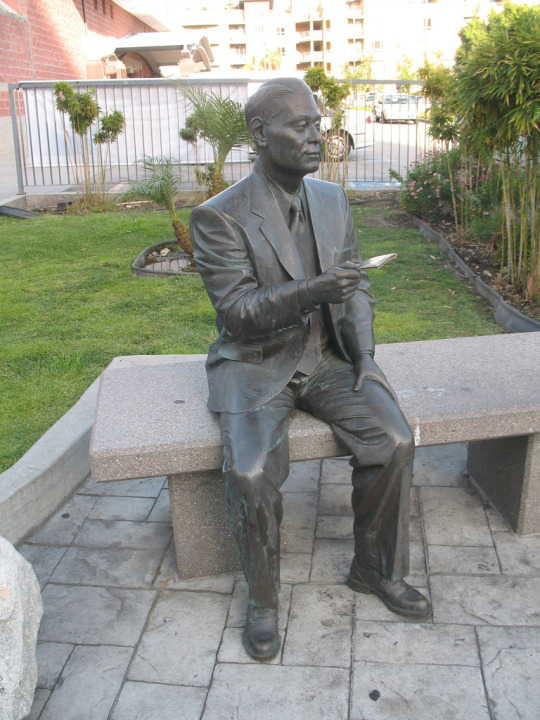
Tucked away in a corner in L.A.’s Little Tokyo is a life-sized statue of Chiune, seated on a bench and smiling gently as he holds out a visa.
The stone next to him bears a quote from the Talmud; “He who saves one life, saves the entire world.”
I had no idea it existed until a few weeks ago, but it’s since become one of my favorite pieces of public art.
Chiune Sugihara. Original antifa.
PBS made a documentary about Chiune Sugihara in 2005. If you’re interested in him, it’s definitely worth checking out. (The PBS link above even has some interactive information to go along with the film.) Ask your local library if they have a copy/can order you one from another library. You won’t be disappointed!
In nations that have known the horror of dictatorship or foreign occupation, there are often long traditions of what Poland’s national poet
once called “patriotic treason.” In Polish history, this kind of
activity has ranged from armed resistance — in the 19th century against Russian occupation, in the 20th century against the Nazis
— to peaceful efforts by bureaucrats who quietly tried to work “within
the system” on behalf of their country. I once researched the story of a
Polish culture ministry official who churned out Stalinist prose but
also used her position, during the years of communist terror, to quietly
help dissident artists.
In occupied countries, large public events can spontaneously take on political overtones, too. When the Czech hockey team beat
the Soviet Union at the world championships in 1969, one year after the
Soviet invasion of the country, half a million people flooded the
streets in a celebration that became a show of political defiance. In
1956, 100,000 people came to the reburial of a Hungarian politician who had been murdered following a show trial. The funeral oratory kicked off an anti-communist revolution a few days later.
I
am listing all these distant foreign events because at the moment they
have strange echoes in Washington. Sen. John McCain’s funeral felt like
one of those spontaneous political events. As in a dictatorship, people
spoke in code: President Trump’s name was not mentioned, yet everybody understood that
praise for McCain, a symbol of the dying values of the old Republican
Party, was also criticism of the authoritarian populist in the White
House. As in an occupied country, people spoke of
resistance and renewal in the funeral’s wake. Since then, public
officials have also described, anonymously, new forms of “patriotic
treason” within the White House and in comments to Bob Woodward and the New York Times. As in an unlawful state, these American officials say they are quietly working “within the system,” in defiance of Trump, for the greater good of the nation.
There
can be only one explanation for this kind of behavior: White House
officials, and many others in Washington, really do not feel they are
living in a fully legal state. True, there is no communist terror; the
president’s goons will not arrest public officials who testify to
Congress; no one will be murdered if they walk out of the White House
and start campaigning for impeachment or, more importantly, for the
invocation of the 25th Amendment, the procedure to transfer power if a
president is mentally or physically unfit to remain in office.
Nevertheless, dozens of people clearly don’t believe in the legal
mechanisms designed to remove a president who is incompetent or corrupt.
As the anonymous op-ed writer put it in the New York Times, despite “early whispers within the cabinet of invoking the 25th Amendment,” none of the secret patriots “wanted to precipitate a constitutional crisis” and backed off.
You
can imagine why this would be. Leading members of Congress might resist
invoking the 25th Amendment, which would of course be described by
Trump’s supporters as a “Cabinet coup.” The mob — not the literal,
physical street mob, but the online mob that has replaced it — would
seek revenge. There may not be any presidential goons, but any senior
official who signs his or her name to a call for impeachment or removal
will certainly be subjected to waves of hatred on social media, starting
with a denunciation from the president. Recriminations will follow on
Fox News, along with a smear campaign, a doxing campaign, attacks on the
target’s family and perhaps worse. It is possible we have
underestimated the degree to which our political culture has already
become more authoritarian.
Maybe we have also
underestimated the degree to which our Constitution, designed in the
18th century, has proved insufficient to the demands of the 21st. In
2016, we learned why it matters that our electoral college — originally
designed to put another layer of people between the popular vote and the
presidency, or as Alexander Hamilton wrote,
to ensure “that the office of President will never fall to the lot of
any man who is not in an eminent degree endowed with the requisite
qualifications” — has become a stale fiction. Now an important
constitutional amendment seems, to the men and women who are empowered
to use it, too controversial to actually use.
The result: institutional and
administrative chaos; our military chain of command is compromised;
people around the elected president feel compelled to act above the law
and remove papers from his desk. The mechanisms meant to protect the
state from an incompetent or dictatorial president are not being used
because people in power no longer believe in them, or are afraid to use
them. Washington feels like the capital of a state where the legal order
has collapsed because, in some ways, it is.
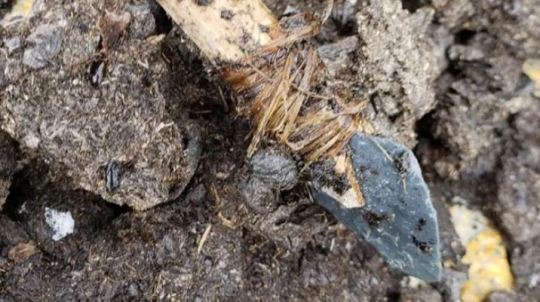
At first, Jennifer Herkes didn’t realize what had been found — she thought it was a piece of an atlatl dart.
“I thought, ‘Oh yeah, that’s neat,’” she recalled.
Then she saw it wasn’t just a piece — it was the whole spear.
“My heart rate started increasing, and I got goose bumps all over. I’d never seen anything like that before, it was amazing,” said Herkes, who is the heritage manager for the Carcross/Tagish First Nation in Yukon.
“The feathers, the sinew, the sap they would have used as, like, a glue to attach the stone point to the wood shaft — all of it is completely intact.“
Herkes believes it’s the first full atatl spear ever found in Yukon. It’s believed to be at least 1,000 years old. Read more.










































 Cheloneuniverse