fun fact: it takes about five months for babies to develop depth perception.
related fun fact: babies as young as five months old show consciousness–that is, they actively process their surroundings rather than simply reacting to stimuli.
conclusion: all the reincarnation si/oc fics where people are conscious in the womb or while being birthed and where they are able to see clearly within like a week of being born are fake and you actually just kinda come to yourself slowly as a baby. you realize one day that you’re a baby and by that point you’re already integrated into another family and going through developmental milestones
I think starting with birth is a genre convention that Silver Queen popularized with Dreaming of Sunshine, although DoS did actually address what you’re talking about in your post somewhat:
But like I said before, I was born to Shikaku and Yoshino Nara in the Konoha General Hospital on the 22nd of September as the younger of twins. It sounds so amazing when said like that. A spiritual miracle. The truth was, at the time I had no idea what was happening. I was twisted and squeezed and the comforting darkness in which I had rested was torn away. There was pain and cold and terror. There was immediacy. Things that hadn’t seemed important were suddenly at the forefront of my mind; what had happened; where was I; was I alive or dead, hurt or injured; what was going on?
I couldn’t tell.
When babies are born, their eyes are incredibly undeveloped. The entire world was a blur to me. It wasn’t quite colour blindness, but the easiest thing to see was the stark contrast between light and dark. I could see shapes and edges but the world looked incredibly confusing.
SQ also spends all of the prologue/first chapter summarizing, moving thing along at a nice clip, and talks about all of it in the past tense. From the writing in the first chapter, it’s apparent that Shikako is literally remembering this and telling the reader about it, rather than experiencing it as we read, so it’s always made sense to me as like… the way Shikako makes sense of what she remembers, leading up to her fulling realizing what’s happened at the end of the chapter when first her eyes fully develop so she can see details and then finally she goes outside and sees the Hokage faces on the mountain.
That being said, I would love to see the SI/OC genre move away from starting with birth because babies and young kids have no agency, both literally in real life and also as characters. I guess in Naruto a kid as young as four or five might be training to kill people, might actually be sent to kill people, but that’s not going to be the case for most characters. I really liked @sage-thrasher‘s cold open in Sanitize, which starts with the insert being about 10 years old.
good point about DoS popularizing certain SI/OC conventions. i don’t necessarily mind this particular convention in most cases–i’ve come to expect it from the naruto fandom, at least–but i wrote this post after reading a fic from another fandom (which… probably had DoS’ genre influence, yeah) wherein the main character was outed as not being a normal baby within a week of being born.
a week.
because of a myriad of things that boiled down to “clearly, having the memories of an adult means that the body of a baby is nearly entirely overwritten. the necessary developmental milestones are met with alarming alacrity through a combination of an adult mind and determination. language and cultural barriers expected from a native english speaker finding themselves in a country whose predominant language is not english are ignored with great prejudice, allowing a one-year-old to have a vocabulary that is more vast than her eight-year-old brother’s.”
i’m like Please. Please. Remember You’re Writing A Literal Baby?
like… if you’re going to start from birth, you can’t just… Speed Through Development? you are purposely starting with the most vulnerable point of a life, where your character is physically and cognitively unable to take care of themselves. being an adult in mind is not going to help you walk and talk at five months old. if you want your character to be able to do things, Don’t Start At Birth, Where They Cannot Do Things?
like–summing this part up as “they have no agency” is so true. it’s a convention, yes, but the characters have no agency. they literally cannot do anything. they’re a baby! they’re a small child! you don’t look at a baby and think, “yes, this baby is going to catalyze great change and avert this world from imminent disaster.” they’re a BABY. they’re learning how to crawl and roll over. they’re not the savior of any world right now.
like, fanfic writers, it’s okay to skip over narrating your character’s birth. it’s okay to skip over the first few years of their life. having to write someone’s entire life is never going to be a requirement.
(Sidenote — man sometimes it’s crazy how so much of this genre can be tracked back to DoS??? possibly even the term SI/OC itself like. damn. although peggy sue time travel stories do sometimes go all the way back to birth as well, I think.)
I have a looong post halfway written up about how I think fanfiction writers just like…. forget that they don’t have to tell stories 100% linearly and also forget that they can just… mention past events…. because they learn to stop doing the italicized flashback and then are like “clearly all kinds of flashback are bad” and then struggle with like. how to cover events before the start of their plot. Thus: start with being a baby, because otherwise how could the reader possibly learn about the baby years?
But yeah I totally agree most stories really, REALLY don’t need to start from birth, even SI/OC stories. Dreaming of Sunshine was about exploring the worldbuilding of Naruto from the very start and lots of the childhood things serve to set up later character development and things, and I think covering childhood very briefly can be good for SI/OC stories, but so often it just seems like they’re just checking it off the list. Or like they want to make sure that their MC is really really justified in the skills they have when it comes time to (in the case of Naruto fic) be a genin, possibly because of fear of the Dreaded Mary Sue Label… even though as long as they’re at an appropriate level most readers will just accept that they have those skills and move on if they open with them.
Anyway, I’m right there with you. It drives me crazy like 90% of the time to have the MC be a baby or a toddler, even with an adult mind. It’s fine if authors wanna write that! They should live their dreams! But they should also consider whether that’s… really… the best place to start….
shoutout to this nameless, generic Snow ninja for being focused + bored at all the carnage
this is just another day on the job for him, and it sucks:
no jumps
no flips
no cool jutsu
he doesn’t even get to show off how good he is at throwing kunai, even though he’s probably been training his whole life to throw kunai real good, since he’s a ninja and all.
no, this guy’s job is to just… turn that crank.. and probably try not to get frostbite, because I see that despite this task taking absolutely no manual dexterity, no one’s provided full gloves for this poor man. that crank is totally metal! it’s below freezing on top of a mountain!!! he should complain to his union reps.
RIP nameless, faceless, characterizationless Snow ninja, who only got a few seconds of screentime but who i nonetheless loved deeply. you were cut down exploded in the prime of your life by uchiha sasuke and will absolutely be forgotten sorry 😥
okay i KNOW that Naruto is the protagonist of the Land of Snow movie because Naruto Is The Protagonist but frankly???? what a mistake. if i were going to rewrite this movie (which… don’t tempt me) and if this movie were allowed to have real character growth and important character moments….
Naruto should learn a lesson from the princess
it’s a Naruto movie and the plot kind of demands that she still go through with it, but as much as this is a story about the princess realizing that she can’t give up, this should also be a story where Naruto makes a real, emotional connection with the princess.
at the beginning of the movie the princess doesn’t want to sign autographs.
she’s like what’s so special about my autograph? you’ll shove it in a drawer and it’ll collect dust. it’s “useless” and a “waste of time”.
meanwhile Naruto gets caught up in fannish excitement and chases down her horse! he also calls her by her character name for like the first half of the movie.
Naruto should have gotten to learn why the princess felt her fame as an actress was “a joke”!
in the end of course the only person we really get to see change is the princess, who (because this is a nart movie) discovers that actually she just had to believe in herself and Naruto all along and she was, idk, wrong for being scared of being literally murdered by the powerful dude who literally murdered her father.
Naruto could have had a real conversation with her about how empty her life has been since she left Land of Snow and how isolated she’s been by her trauma and fear. Naruto could hear, in her explanation of how meaningless her fame is, an echo of his own loneliness. Naruto could have looked past her film persona and actually really connected with her in a way the rest of the team couldn’t!
furthermore, he could realize that his quest to be recognized and loved by the village, although a perfectly fine goal, could become an empty dream if he doesn’t really focus on being recognized and loved for the right reasons.
at the end of the movie when the princess is gladly signing autographs, Naruto would get to see that this fame and adoration brings her joy because it’s based around her doing something really good for these people, not around who they think she is, and the autograph that he has from her would be super meaningful.
(ok, it’s already a little meaningful because Sasuke got it for him, but you know what I mean.)
Listen, I hear what you’re saying, but Young Sam being the deadly combo of his mother’s powerful Ladies Who Organize tendencies, and his father’s stubborn anti-authority pragmatism makes him an ideal community organizer. He’s cheerful and unflagging and drinks coffee at a rate that would impress even Maladict; he has a dartsboard in his office with an iconograph of Lord Downey II pinned to it, and when asked his response is invariably a chilly, “he knows what he did.”
When you look deeply in his eyes you can see the abyss looking back.
(It wants to know if you’ve signed that petition yet.)
“Okay, okay, I’m going to tell you what Hermione sees in Ron. A trio is a balancing act, right? They’re equalizers of each other. Harry’s like the action, Hermione’s the brains, Ron’s the heart. Hermione has been assassinated in these movies, and I mean that genuinely—by giving her every single positive character trait that Ron has, they have assassinated her character in the movies. She’s been harmed by being made to be less human, because everything good Ron has, she’s been given. So, for instance: “If you want to kill Harry, you’re going to have to kill me too”—RON, leg is broken, he’s in pain, gets up and stands in front of Harry and says this. Who gets that line in the movie? Hermione. “Fear of a name increases the fear of the thing itself.” Hermione doesn’t say Voldemort’s name until well into the books—that’s Dumbledore’s line. When does Hermione say it in the movies? Beginning of Movie 2. When the Devil’s Snare is curling itself around everybody, Hermione panics, and Ron is the one who keeps his head and says “Are you a witch or not?” In the movie, everybody else panics and Hermione keeps her head and does the biggest, brightest flare of sunlight spell there ever was. So, Hermione—all her flaws were shaved away in the films. And that sounds like you’re making a kick-ass, amazing character, and what you’re doing is dehumanizing her. And it pisses me off. It really does. In the books, they balance each other out, because where Hermione gets frazzled and maybe her rationality overtakes some of her instinct, Ron has that to back it up; Ron has a kind of emotional grounding that can keep Hermione’s hyper-rationalness in check. Sometimes Hermione’s super-logical nature grates Harry and bothers him, and isn’t the thing he needs even if it’s the right thing, like when she says “You have a saving people thing.” That is the thing that Harry needed to hear, she’s a hundred percent right, but the way she does it is wrong. That’s the classic “she’s super logical, she’s super brilliant, but she doesn’t know how to handle people emotionally,” at least Harry. So in the books they are this balanced group, and in the movies, in the movies—hell, not even Harry is good enough for Hermione in the movies. No one’s good enough for Hermione in the movies—God isn’t good enough for Hermione in the movies! Hermione is everybody’s everything in the movies. Harry’s idea to jump on the dragon in the books, who gets it in the movies? Hermione, who hates to fly. Hermione, who overcomes her withering fear of flying to take over Harry’s big idea to get out of the—like, why does Hermione get all these moments? [John: Because we need to market the movie to girls.] I think girls like the books, period. And like the Hermione in the books, and like the Hermione in the books just fine before Hollywood made her idealized and perfect. And if they would have trusted that, they would have been just fine. Would the movies have been bad if she was as awesome as she was in the books, and as human as she was in the books? Would the movies get worse? She IS a strong girl character. This is the thing that pisses me off. They are equating “strong” with superhuman. To me, the Hermione in the book is twelve times stronger than the completely unreachable ideal of Hermione in the movies. Give me the Hermione in the book who’s human and has flaws any single day of the week. Here’s a classic example: When Snape in the first book yells at Hermione for being an insufferable know-it-all, do you want to know what Ron says in the book? “Well, you’re asking the questions, and she has to answer. Why ask if you don’t want to be told?” What does he say in the movie? “He’s got a point, you know.” Ron? Would never do that. Would NEVER do that, even before he liked Hermione. Ron would never do that.”
—
Melissa Anelli THROWS IT DOWN about the way Ron and Hermione have been adapted in the movies on the latest episode of PotterCast. Listen here. This glorious rant starts at about 49:00. (via karakamos)
I’m quoting this ‘cause Melissa calls it out so hard that Kloves and Yates are hurting from the thumping – and I have absolutely NOTHING to add to it.
this is perfection, but can we possibly throw in the character shift for Ginny as well? perhaps it’s not as drastic as Hermione’s, but I think that’s only because Ginny (alongside Neville and Luna) takes a backseat to a lot of the goings-on, in both the movies and the books.
but I can’t tell you how many times I’ve heard people say they HATE movie!Ginny — mainly because she was mostly used for sex appeal (coughDH1cough) and we never got to see her personality and understand what attracted Harry to her in the films.
yes we see her helping Harry with Quidditch tryouts in HBP and probably the best Ginny moments are the DA practices in OotP, but aside from that we don’t hear things like “she learned to fly so well because she’s been stealing each of her brother’s brooms from the broom shed and practicing since the age of six” or “size is no guarantee of power”. I adore book!Ginny with all my heart because she is perfect for Harry — I mean, I could never seriously see Harry and Hermione working out because of her complete lack of interest in his favorite subject: Quidditch. Whereas he and Ginny could talk for hours about it and not get bored.
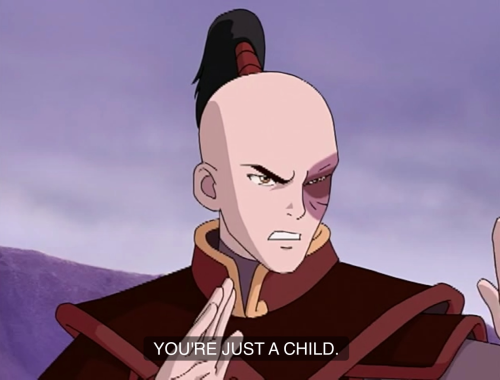
Sometimes I think about the fact that there is exactly one time that we hear someone express surprise at the fact that Aang–the Avatar– and his companions are children. And it’s in the second episode, from Zuko:
From an out-of-universe perspective, this makes sense. And it wasn’t something that surprised me when I was a ten-year-old in 2005 when A:tLA first aired. One of the tenants, I think, of adventure children’s television is that there is a degree of wish fulfillment. Children want to be taken seriously as agents, and so it makes sense from that vantage point, that everyone takes the Gaang seriously as agents except the person portrayed as an antagonist.
But, I think this also makes sense, heart-breakingly and unlike other children’s adventure television, from an in-universe perspective. This is a world ravaged by bloody, bloody war for a hundred years. A world in which child soldiers are commonplace. We see countless examples of this throughout the series:
When we meet Sokka–fifteen-years-old and in-charge of security for his village–he is training small children to be soldiers. This is played off as something of a laugh, but if Aang hadn’t returned in the second episode, I think we’re supposed to think that Sokka very much would have tried to lead these little boys into battle.
Jet and the Freedom Fighters, who practice guerrilla warfare (fairly successfully) and regularly raid Fire Nation outposts, are children. Jet, who I think we are supposed to assume is one of the eldest of the group, is sixteen when he dies (according to the Avatar wiki).
The Kyoshi Warriors are one of the elite-most fighting force in Avatar World, eventually taken seriously by the Earth Kingdom military and given military jobs. And the general of the Kyoshi Warriors, Suki, and the eldest member of the group (again according to the Avatar wiki) is fifteen. She can’t have always been the eldest member. I’m willing to bet the older women are sent off to war, and Suki becomes the eldest member and the leader by default. (Much like Sokka–probably why they connect so well).
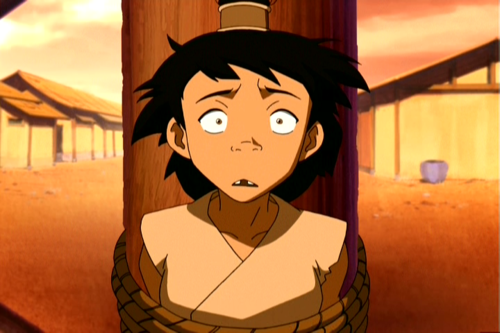
In Zuko, Alone, the soldiers in the village threaten to send Lee off to join the army at the front, and based on the mother’s reaction, and what we see of him when he’s tied up, this doesn’t seem like an empty threat, and it’s probably not the first time this has happened to children in the Earth Kingdom in villages like these.
I could go on.
So of course, after living in a world of child soldiers like these, no one is going to bat an eyelash to learn that the Avatar–perhaps the ultimate non-Fire Nation soldier–is twelve-years old, and his companions aren’t much older. When Aang starts to bring this up himself to Yue, for instance, Yue doesn’t seem to understand. He’s the Avatar, he has to save them, she insists. Who cares if he’s a child?
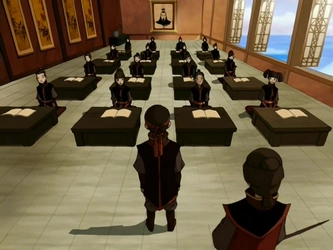
But the Fire Nation Army isn’t filled with child soldiers. It doesn’t need them. Fire Nation children are in school. It is adults that make up the Fire Nation Army.
And, (with the exception of Azula and her gang), when we do see a Fire Nation child attempting to take on the role of an adult member of the military, he isn’t taken seriously. (E.g. Zuko, and the way Zhao brushes him off.)
So of course it is only Zuko, who grew up in the absolute center of the Fire Nation, and, though he is banished, hasn’t really seen much of the reality of the war until he meets Aang, that looks at the Avatar and remarks in surprise that he is a child.
(If anyone is interested, I wrote a fic that deals with a lot of these themes. It can be found here.)










 Cheloneuniverse